
How to Choose a Landscaping Company: A Homeowner's Checklist
Table of Contents
Hiring a landscaper is one of the few home service decisions where the consequences last for years. A badly built patio settles, a wrongly graded yard sends water at a foundation, a mismatched maintenance program thins out a lawn over two seasons, and none of it is obvious on the day the crew drives away. The good news is that the companies who do this well are not hard to identify, because they behave differently at the estimate stage. They ask more questions than you do, they put exclusions in writing, and they can produce paperwork within a day. This checklist covers what to verify, what to require in the estimate, how to read references, and the warning signs that reliably predict problems.
What should you verify before hiring a landscaper?
Verify business registration, any licensing your jurisdiction requires for the specific work, general liability insurance, workers compensation coverage, and, for pesticide or irrigation work, the applicable applicator or contractor licence. Ask for a certificate of insurance sent directly from the insurer or broker.
Workers compensation is the coverage homeowners forget and the one that matters most. If an uninsured worker is injured on your property, the claim can land on your homeowner policy, and the amounts involved are not small.
Licensing varies widely by jurisdiction. Mowing and bed maintenance are often unlicensed, while pesticide application, irrigation backflow work, tree removal, and structural retaining walls usually are not.
Our guide on landscaping business insurance explains exactly which policies a legitimate operator carries, which makes it easier to tell a real certificate from a screenshot.
What should a landscaping estimate include?
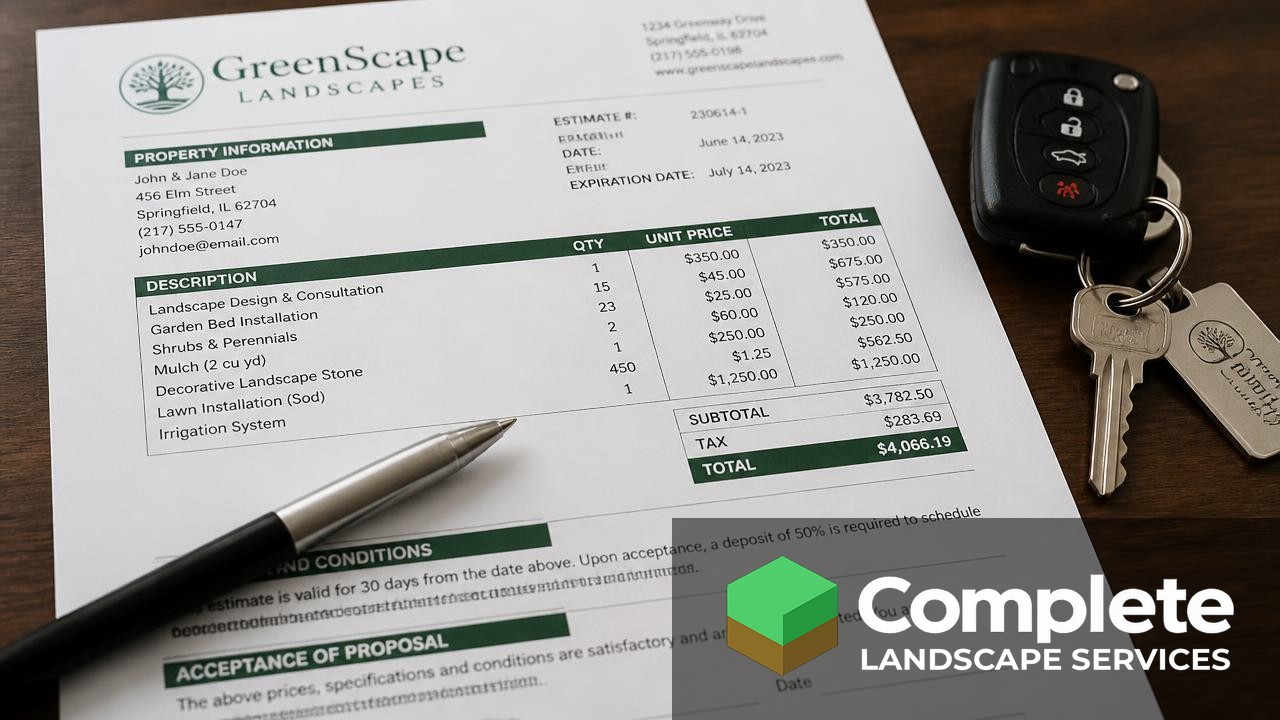
A usable estimate names the scope by task, quantities and materials by specification, the schedule, the payment terms, the exclusions, and the warranty on workmanship and plant material. A single line item with one price is not an estimate, it is a number.
Quantities are what make bids comparable. Square footage of paving, cubic yards of base, plant sizes by container, mulch depth, and linear feet of edging turn three quotes into an apples-to-apples comparison.
Exclusions matter as much as inclusions. Permits, disposal, utility locates, unsuitable soil, irrigation modification, and restoration of damaged turf are the six most common change order triggers.
For the clause-by-clause detail on what a signed agreement should say, see our guide on landscaping contracts and what to include.
How many quotes should you get?
Get three, from companies of broadly similar size, all pricing the same written scope. Without a common scope you are comparing different projects, which is why bid spreads of 200 percent or more are so common on residential landscape work.
Write your scope before the first visit. Even a single page listing what you want done, at what standard, and by when, produces dramatically more comparable bids.
Discard the extreme outliers and ask why. A bid far below the others usually omitted base depth, drainage, or disposal, and a bid far above may have identified a real site condition the others missed.
If you want to understand the cost logic behind the numbers, our guide on how much landscaping costs sets out typical ranges by project type.
| Item | What to ask for | Why it matters |
|---|---|---|
| Scope | Task-by-task written description | Most price variance hides here |
| Quantities | Square footage, yardage, plant sizes | Makes bids directly comparable |
| Base and materials | Depth and specification | Determines whether hardscape lasts |
| Exclusions | Explicit written list | Predicts change orders |
| Schedule | Start and completion dates | Shows real capacity |
| Warranty | Workmanship and plant terms | Separates operators from crews |
| Insurance | Certificate from the insurer | Protects you from claims |
How do you check references properly?
Ask for three references on work similar to yours, completed one to three years ago rather than last month. Recent jobs show appearance; older jobs show whether the drainage, base work, and plant selection actually held up.
Ask references specific questions: did the final price match the estimate, how were change orders handled, did the crew show up when promised, and did anything need to be corrected afterward.
Look at online reviews for patterns rather than scores. One angry review means little, while five reviews mentioning the same communication failure means a lot.
Ask to see a current job in progress. A tidy, organized active site tells you more about how your project will be run than any finished photo can.
What are the red flags?
The reliable warning signs are large upfront deposits, cash-only pricing, no written estimate, no verifiable insurance, pressure to decide immediately, door-to-door solicitation with leftover materials, and an unwillingness to put exclusions in writing.
Deposits above roughly a third of the project value are unusual for residential landscape work, and full payment before work starts is never appropriate.
Be careful with a contractor who agrees to everything without asking about drainage, soil, utilities, or how you actually use the space. Good ones interrogate the site before they price it.
A vague plant warranty is another signal. Reputable firms warrant installed plant material for a season or a year with defined watering conditions, and they say so in writing.
Should you hire a maintenance company or a design build firm?
Hire a maintenance company for recurring care such as mowing, beds, fertilization, and cleanups, and a design build firm for construction work such as patios, walls, grading, and plantings. Some companies do both well, but most are genuinely stronger at one.
Ask which side of the business is larger. A maintenance company that builds a few patios a year is a different proposition from a firm that builds them every week.
For construction work, ask who will actually be on site and whether any trades are subcontracted. Subcontracting is normal, but you should know whose warranty covers what.
Our overview of what landscaping companies do maps the full range of services and which specialties are typically handled in house.
Frequently Asked Questions
The bottom line
Choosing a landscaper is a paperwork exercise disguised as a taste decision. Write your scope, collect three bids against it, verify insurance directly with the insurer, read the exclusions before the price, and call references on work that is a few years old. Contractors who clear that bar reliably produce projects that still look right in year five, which is the only test that matters.
Thinking bigger picture? Read our full guide on How to Start a Landscaping Company, or visit our member directory to connect with vetted Complete Landscape Services professionals.
Need professional help?
Browse our member directory to find trusted Complete Landscape Services professionals for commercial landscaping and more.
Our Member Directory