
Snow Removal Services: Pricing, Contracts, and What to Expect
Table of Contents
Snow removal is the only landscape service where the product is availability. Anyone can clear a parking lot; what a property is actually buying is a guarantee that a crew will be there before the morning rush after a storm that started at midnight. That is why snow pricing looks strange compared with summer work, why contracts are signed in September and October, and why the cheapest provider in November is frequently the one that does not answer the phone in January. This guide explains the three pricing models, what a trigger depth is, how salting and ice management are billed, the liability issues that make documentation important, and how to choose between contract types for a home, a small business, or a large commercial site.
How much does snow removal cost?
Residential driveway clearing runs $40 to $120 per visit or $350 to $900 for a seasonal contract in most North American markets. Small commercial lots run $150 to $400 per event, and larger lots with sidewalks and salting commonly run $500 to $2,500 per event depending on area and snowfall depth.
Price scales with area, obstacle count, and where the snow has to go. A lot with a convenient storage corner is far cheaper to service than one where snow must be stacked carefully or hauled off site, and hauling is billed separately at $200 to $500 per truckload in dense urban areas.
Sidewalks and entrances are labor rather than equipment, so they carry a different rate than plowing. On properties where pedestrian areas are extensive, the walk clearing line item can exceed the plowing line item.
Salting and ice melt are almost always billed separately by application or by material weight, because a mild winter with frequent freeze-thaw cycles can require more salt events than plow events.
| Model | How it works | Best for | Risk sits with |
|---|---|---|---|
| Per event | Flat fee each time service is triggered | Variable winters, cost-conscious sites | Property owner |
| Per season | Fixed total for the whole winter | Budget certainty, commercial sites | Contractor |
| Per inch tier | Rate rises with snowfall depth bands | Regions with wide storm variability | Shared |
| Time and materials | Hourly equipment plus material used | Large or unpredictable sites | Property owner |
What is a trigger depth and why does it matter?
The trigger depth is the accumulation at which the contractor is obligated to service the property without being called, commonly 1 to 2 inches for commercial sites and 2 to 3 inches for residential. Anything below the trigger is not serviced unless you request it, usually at an additional rate.
Trigger depth is the most consequential number in a snow contract and the one most often skimmed over. A 3-inch trigger on a medical or retail property leaves pedestrians on packed snow through most of a typical winter.
Zero-tolerance contracts specify continuous service during an event to keep surfaces clear at all times. They cost substantially more and are used where liability exposure justifies it, such as hospitals and high-traffic retail.
Clarify what happens during multi-day storms. Some contracts count a continuous event as one service, others bill per push, and the difference over a long storm can be several times the base rate.
How does ice management and salting work?
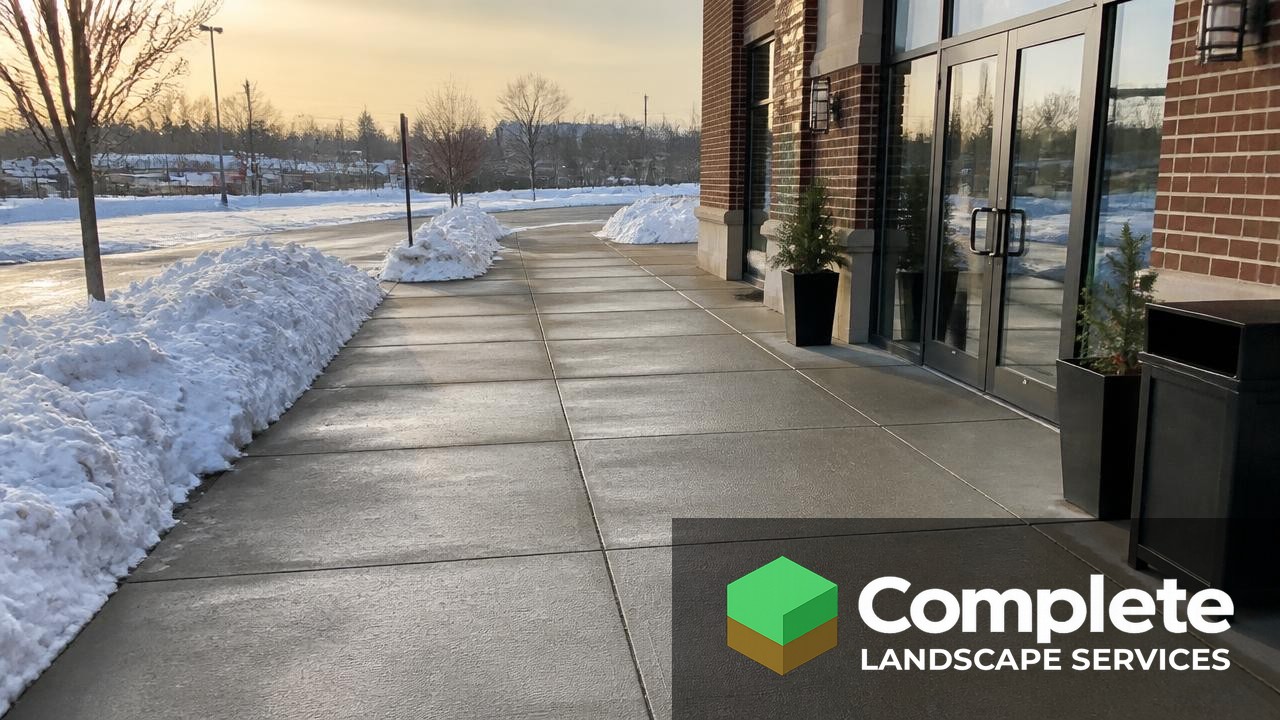
Ice management uses de-icers applied after clearing, or anti-icing brine applied before a storm to prevent bonding. Rock salt works down to about 15 degrees Fahrenheit, while calcium chloride and magnesium chloride blends work at much lower temperatures and cost more per application.
Pre-treating with brine before a forecast storm is the most cost-effective practice available, because preventing ice from bonding to pavement uses a fraction of the material needed to break it afterward.
Over-salting is expensive and damaging. It corrodes concrete and vehicles, kills adjacent plants, and reaches waterways, which is why several jurisdictions now certify contractors in salt application rates.
Protect plantings along treated surfaces. Our guide on how to protect plants in winter covers salt screening and spring soil leaching for beds beside driveways and walkways.

What should a snow removal contract include?
It should state the trigger depth, response window, scope by surface, snow storage locations, salting terms, pricing model, per-event or seasonal rate, invoicing schedule, insurance limits, and a service log requirement. Documentation of every visit is the core of the agreement, not an administrative extra.
Require a time-stamped service log with photos. In a slip-and-fall claim, the contemporaneous record of when the property was serviced and treated is the primary evidence, and its absence is very difficult to overcome after the fact.
Define snow storage on a site plan. Piles placed over drains, in accessible parking, or in sightline corners create problems that outlast the storm.
Our guide on landscaping contracts and what to include covers the general clause structure, and snow agreements should add trigger depth, response time, and event definition on top of it.
Should you choose a seasonal or per-event contract?
Choose seasonal for budget certainty and guaranteed priority, and per-event if you can absorb variability and your region has inconsistent snowfall. Seasonal contracts transfer weather risk to the contractor, which is why they are priced against an average winter rather than a mild one.
In a heavy winter, a seasonal contract is the clear financial winner. In a mild winter, per-event costs less. Over a five-year span the two usually land close, with seasonal buying predictability rather than savings.
Priority is the practical differentiator. Seasonal clients are serviced on a fixed route before per-event and on-call work, which after a large storm can mean the difference between opening at 8 a.m. and opening at noon.
Book early. Contractors size their fleet and staffing to contracts signed by autumn, and properties added in January are fitted into whatever capacity happens to be left.
What are the liability risks of snow and ice?
Property owners generally carry a duty to keep surfaces reasonably safe, and slip-and-fall claims are among the most common winter liability exposures for commercial properties. Hiring a contractor does not transfer that duty, which is why documentation, response windows, and insurance verification matter.
Verify that your contractor carries adequate general liability with snow operations specifically included, plus workers compensation. Some general liability policies exclude snow and ice operations entirely.
Keep your own records alongside the contractor's. Photos of the property at opening time, retained through the season, cost nothing and answer most of the factual questions a claim raises.
Inspect and repair pavement in autumn. Depressions that hold meltwater refreeze into hazards, and pavement defects are far cheaper to address before the ground freezes than to defend afterward.
Frequently Asked Questions
The bottom line
Snow service is an availability contract, so buy it on terms rather than on rate. Fix the trigger depth, response window, surface scope, and salting terms in writing, confirm insurance that explicitly covers snow operations, require a photographed service log, and sign in autumn rather than after the first storm. A property under a clear, well-documented agreement opens on time all winter, which is the entire point of the expense.
Thinking bigger picture? Read our full guide on How to Start a Landscaping Company, or visit our member directory to connect with vetted Complete Landscape Services professionals.
Need professional help?
Browse our member directory to find trusted Complete Landscape Services professionals for seasonal cleanup and more.
Our Member Directory