
How to Price Landscaping Jobs: A Practical Estimating Guide

Table of Contents
Knowing how to price landscaping jobs is the difference between a busy business and a profitable one. The trap is intuitive pricing: looking at a yard, guessing a number that feels competitive, and discovering months later that the busiest season produced the thinnest bank balance. Professional estimating replaces the guess with a repeatable calculation. You establish a fully loaded crew-hour rate that recovers wages, payroll burden, equipment cost, and overhead. You estimate the hours honestly, including drive and load time. You add materials with a defensible markup. Then you apply a profit margin on top, because profit is a planned line item, not whatever happens to be left. This guide walks through each step with worked numbers.
What is a fully loaded crew-hour rate?
A fully loaded crew-hour rate is what one hour of crew time actually costs your business, including wages, payroll taxes, workers' compensation, benefits, equipment depreciation and fuel, and a share of fixed overhead. For most small landscaping operations it lands between $55 and $95 per person-hour before profit.
Start with the wage. A crew member paid $22 per hour costs closer to $28 or $29 once you add payroll taxes, workers' compensation, and any benefits. That multiplier, usually 1.25 to 1.4, is your labor burden and it is non-negotiable.
Next add equipment. Total your annual equipment costs, meaning payments or depreciation, fuel, maintenance, blades, and trailer upkeep, then divide by your realistic billable hours for the year. A one-crew operation billing 1,400 hours with $21,000 in annual equipment cost is carrying $15 per hour.
Finally add overhead: insurance, licensing, vehicle costs, phone, software, accounting, advertising, and the administrative time you spend quoting and invoicing. Divide annual overhead by billable hours the same way. Add the three together and you have your break-even crew-hour rate.
| Component | Annual amount | Per billable hour (1,400 hrs) |
|---|---|---|
| Wage at $22/hr | $30,800 | $22.00 |
| Payroll burden (30%) | $9,240 | $6.60 |
| Equipment, fuel, maintenance | $21,000 | $15.00 |
| Insurance and licensing | $5,600 | $4.00 |
| Vehicle and trailer | $8,400 | $6.00 |
| Admin, software, marketing | $7,000 | $5.00 |
| Break-even crew-hour rate | $58.60 | |
| With 25% target margin | $78.13 |
How do you estimate the hours a job will take?
Break the job into tasks, assign a production rate to each, and add drive time, load and unload, setup, and cleanup. Production rates come from your own tracked data, not from industry averages. Until you have that data, estimate conservatively and record actual hours on every job.
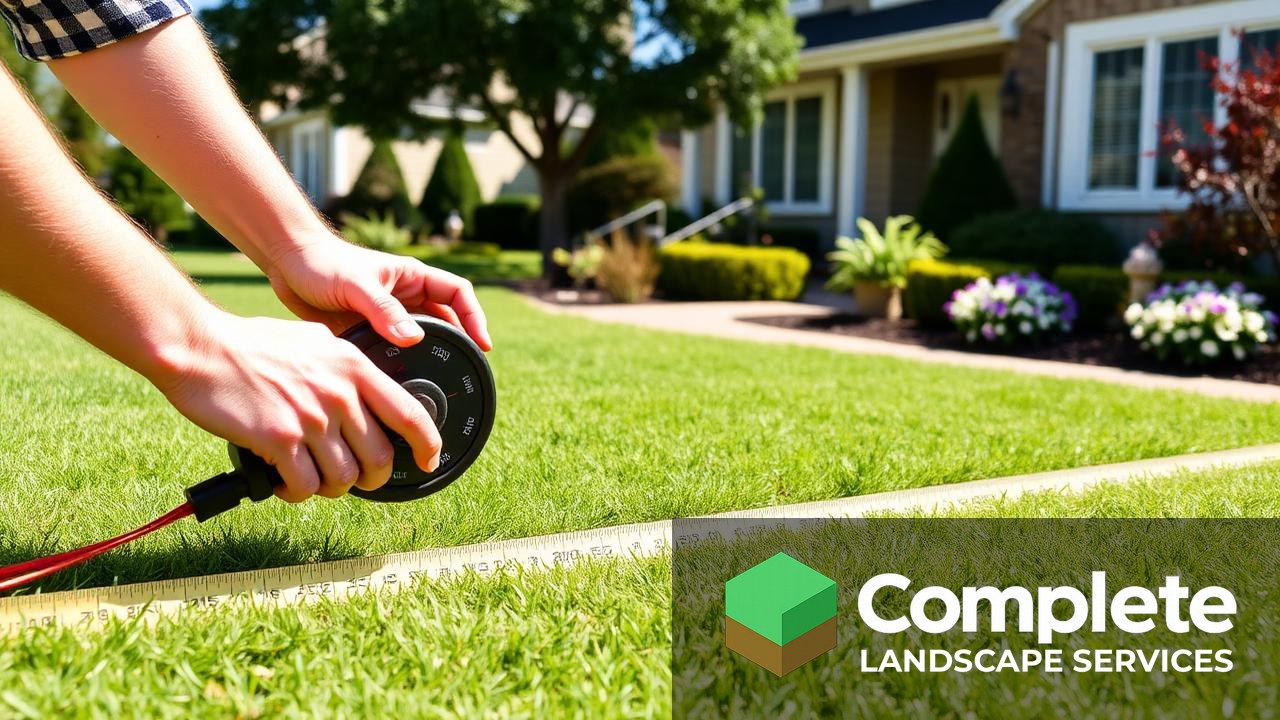
Measure the site properly. A measuring wheel and a phone with a satellite measurement app take five minutes and remove the largest source of estimating error. Square footage of turf, linear feet of edging, and bed area are the three numbers most jobs turn on.
Add the non-productive time everyone forgets: travel between properties, loading and securing equipment, fueling, disposal runs, and the fifteen minutes of client conversation at the end of a visit. On a small residential maintenance route this can be 25 to 35 percent of the day.
Then track. Have crews log start and finish times per property for one full season. After a few months you will know that your two-person crew mows and trims a typical quarter-acre lot in 42 minutes, and every future quote for that property type becomes arithmetic rather than a guess.
How much should you mark up materials?
Standard material markup in landscaping is 20 to 50 percent, with 30 to 35 percent being typical for plants, mulch, and aggregate. The markup covers sourcing time, pickup and delivery, handling, waste, and warranty replacement of plants that fail, so it is a service charge rather than pure profit.
Do not confuse markup with margin. A 30 percent markup on a $100 item produces a $130 price and a 23 percent margin. If you want a 30 percent margin you need a 43 percent markup. Getting this wrong is one of the most common ways small contractors quietly lose money.
Plant material justifies markup at the higher end because of shrinkage and warranty. If you replace failed plants in the first season as a matter of policy, and you should, that cost has to live somewhere.
Bulk materials such as mulch, soil, and aggregate are usually quoted per unit installed rather than as material plus labor. That keeps the client focused on a single comparable number and protects your margin structure from line-item negotiation.

Should you charge hourly, per square foot, or a flat rate?
Quote a flat rate to the client and calculate it hourly internally. Flat pricing is what clients want, it rewards your efficiency, and it avoids the perverse incentive of hourly billing. Per square foot pricing works well for repeatable production work such as mulch installation, sod, and mowing.
Hourly billing should be reserved for genuinely unpredictable work: storm cleanup, overgrown property restoration, and open-ended problem solving. State a rate and an estimated range, and update the client the moment the range is at risk.
Per square foot rates are a shortcut, not a substitute for the crew-hour math. Derive them from your own hourly costs so they hold up. For example, if a crew installs mulch at 12 cubic yards per day at a loaded cost of $940 per crew day, your delivered installed price per yard follows directly from that.
Whatever structure you use, put it in writing. Ambiguity about what is included is the source of most payment disputes, and our guide to what to include in a landscaping contract covers the scope, change order, and payment clauses that prevent them.

How do you price recurring maintenance contracts?
Calculate the per-visit cost from your crew-hour rate, multiply by the number of visits in the season, add seasonal extras such as spring and fall cleanups, then divide the annual total into equal monthly payments. Monthly billing smooths cash flow for both sides and improves client retention.
Build in a route density assumption and protect it. A property that sits fifteen minutes from your nearest other client costs materially more to service than one on an existing route, and either the price or the routing should reflect that.
Include an annual escalation clause of 3 to 5 percent so you are not renegotiating from scratch each spring while absorbing wage and fuel increases in the meantime.
Define what is excluded as clearly as what is included. Storm damage, irrigation repair, pest treatment, and plant replacement are common exclusions that become uncomfortable conversations when the contract is silent on them.
What are the most common landscaping pricing mistakes?
The five most costly mistakes are omitting overhead, ignoring drive and load time, confusing markup with margin, competing on price against underinsured operators, and never comparing estimated hours to actual hours. Each one is invisible in the moment and obvious at year end.
Pricing against the cheapest bidder in your market is the fastest route out of business, because that bidder is frequently uninsured, unregistered, or simply has not done the arithmetic. Compete on reliability, communication, and finish quality instead, and be willing to lose the jobs that are only about price.
The single most valuable habit is the estimate-versus-actual review. Spend twenty minutes a week comparing what you quoted to what the job took. Within one season your estimates tighten considerably and you will identify exactly which job types are quietly unprofitable.
If you are still working out your cost base, our breakdown of how much it costs to start a landscaping company itemizes the equipment, insurance, and startup figures that feed directly into the overhead side of your rate. And if you are earlier still, how to start a landscaping company covers the business setup that has to be in place before you quote your first job.

Frequently Asked Questions
The bottom line
Profitable pricing is arithmetic, not instinct. Build a fully loaded crew-hour rate, estimate hours honestly including the unglamorous ones, mark materials up deliberately, and add profit as a planned line rather than a hopeful remainder. Then track estimated hours against actual hours on every job, because that single habit will improve your pricing faster than anything else you do. For the commercial side of pricing, see what a commercial landscaping contract costs.
Thinking bigger picture? Read our full guide on How to Start a Landscaping Company, or visit our member directory to connect with vetted Complete Landscape Services professionals.
Need professional help?
Browse our member directory to find trusted Complete Landscape Services professionals for commercial landscaping and more.
Our Member Directory